
When customers ask about wax or paint correction, they are usually trying to solve the same problem. They want their paint to look better and imperfections to disappear. The challenge is that waxing and paint correction do not solve the same issue. They are often grouped together, but they work in completely different ways.
Understanding that difference helps you avoid repeating a process that slowly works against your paint instead of improving it.
Why Wax or Paint Correction Gets Misunderstood
Most vehicle owners have heard waxing described as part of detailing. That creates the assumption that waxing restores the paint. That assumption comes from the way services are presented. The vehicle looks better after, so it feels like the issue was fixed.
What matters is what actually happened to the surface.
What Customers Expect Wax to Do
When someone requests a hand wax, they often expect scratches to disappear and gloss to return. They want the paint to look smooth again. Those expectations come from the result, not the process. The finish looks better, so it feels like the problem is gone.
That is where the misunderstanding begins.
What Wax Actually Does
Wax does not remove defects from the paint. It sits on top of the surface and fills light imperfections temporarily. It adds gloss and makes the paint look darker and more even. The finish improves right after the service. Once the wax wears off, the same defects come back.
What Paint Correction Actually Does
Understanding wax or paint correction starts with understanding how correction works. Paint correction is not a product. It is a process that changes the surface itself.
Paint Correction Removes the Defects
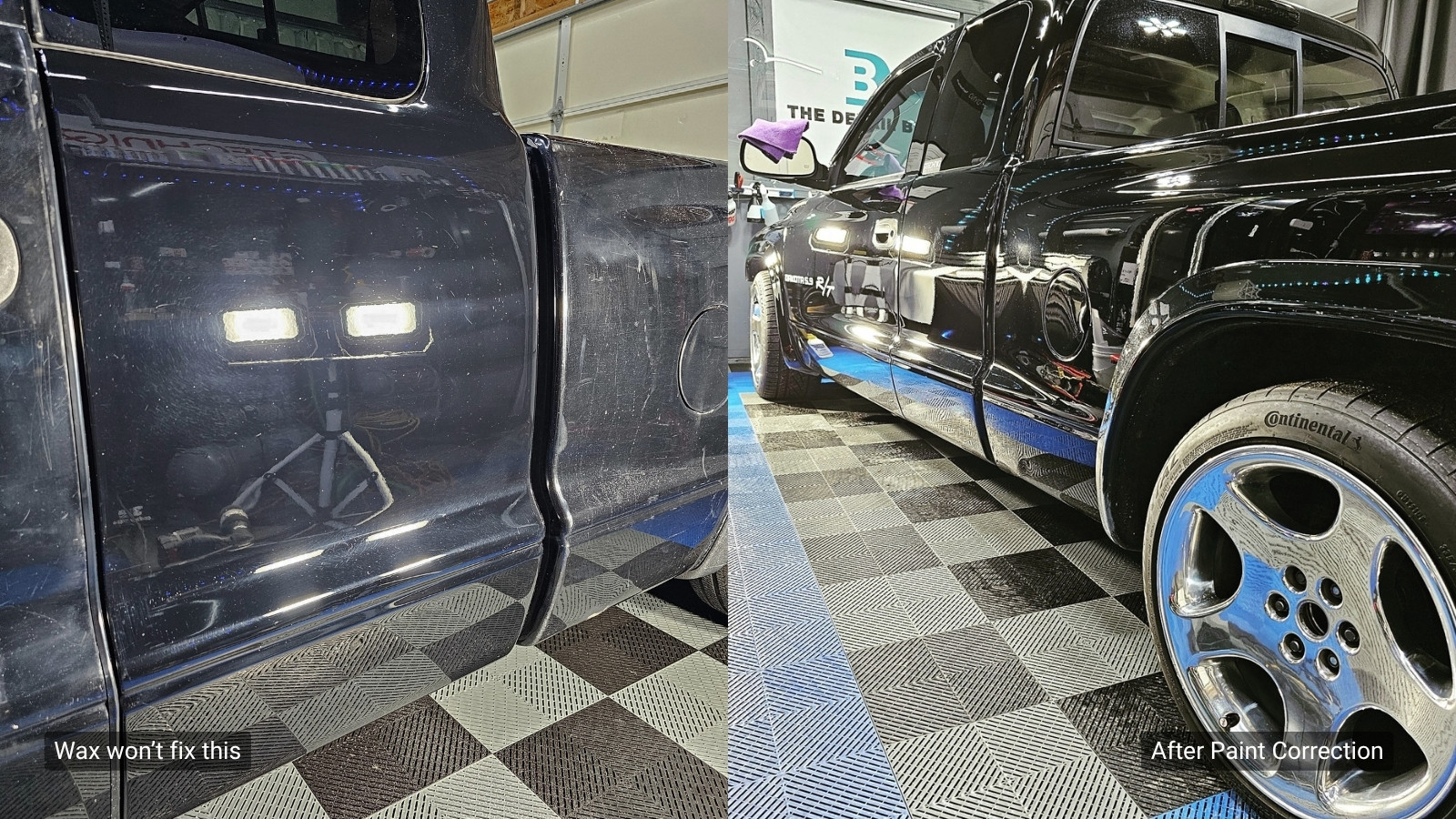
Paint correction removes a small layer of clear coat to level the surface. This process eliminates swirl marks, scratches, oxidation, and haze. The result is a finish that reflects light properly again. The clarity comes from removing the defect, not covering it.
That is why the improvement lasts.
Real-World Example
A black vehicle comes in with visible swirl marks. A wax can improve how it looks for a short time. A proper paint correction process removes those defects, so the finish stays clear after the job is complete. That is the difference between temporary improvement and real correction.
Why This Matters Over Time
When defects stay in the paint, they continue to build. Repeating wax services without correction creates a cycle where the surface never improves. Over time, the paint needs more aggressive work to restore it. What could have been maintained becomes harder to fix.
That long-term impact is often overlooked.
The Step Most People Don’t Realize Comes Before Wax
When customers ask for wax or paint correction, they are usually thinking about the final result. What often gets missed is the step that happens before either of those.
Every vehicle has to go through preparation before protection or correction can be done properly. That preparation step is where most of the problems begin.
Every Vehicle Follows the Same Starting Point
Before a vehicle can be hand waxed or corrected, the surface has to be properly cleaned and decontaminated. This removes anything bonded to the paint that a normal wash cannot remove.
This step exists no matter what the final service is. The difference is how aggressive that step needs to be based on the condition of the paint.
Light Contamination vs Heavy Contamination
Not all vehicles require the same level of decontamination. Some vehicles are well-maintained or in good condition. In those cases, a light method like a clay towel or light clay bar can safely prepare the surface. This allows wax to be applied without introducing damage.
Other vehicles are heavily contaminated. The surface feels rough and bonded buildup has been sitting for a long time. Those situations require more aggressive methods, like a heavy clay bar.
When Decontamination Changes the Service
Aggressive decontamination does not just prepare the paint. It can also introduce marring into the surface. At that point, the vehicle no longer just needs protection. It now needs refinement before protection can be applied correctly.
This is why we evaluate vehicles before recommending a service.
The Hidden Issue with Clay and Wax
This is where the conversation around wax or paint correction becomes more important. It is not just about protection; it is about what happens before that step.
What Clay Bar Actually Does
A Clay bar removes bonded contamination from the surface. It prepares the paint for the next step but is not designed to be the final step before protection on a heavily contaminated vehicle. It should be followed by refinement.
Why a Clay Bar Can Add Marring
A Clay bar creates friction across the paint. Even when used correctly, it can introduce light marring when heavy contamination exists on the paint. This is especially visible on darker vehicles. Black paint shows these defects clearly under proper lighting.
Without correction, that marring remains in the finish.
Real-World Example
We recently had a new client call requesting a clay and wax. They mentioned they had their vehicle detailed this way for years, we had them stop by for a proper inspection because multiple rounds of claying without mention of a paint correction is a red flag, we needed to check condition of paint and contamination level.
Immediately, during his inspection, his vehicle showed consistent marring and swirl patterns as well as heavy contamination.
Each time the vehicle was clayed, small damage was added. Each time it was waxed, those defects were temporarily hidden from the client.
The wax would eventually wear off, the old damage and newly added damage from the last clay session would appear, the client would assume it was time for his clay and wax, and the cycle would repeat itself.
When Wax Is Actually the Right Choice
This is one of the biggest misunderstandings in wax or paint correction. It comes down to how the process is structured. A complete process includes cleaning, decontamination, correction when needed, and protection is 100% okay. It’s skipping one of these steps based on the condition of the vehicle that changes the result.
When Wax Makes Sense
Machine applied wax/hand waxing works best when the paint is already in good condition and only requires a light decontamination step.
This allows it to enhance gloss and provide short-term protection. The finish looks better because the surface underneath is correct.
When Wax Does Not Make Sense
Wax is not the right solution when a vehicle requires heavy decontamination or has visible defects such as scratches, haze, or oxidation. In these situations, the surface is no longer in a condition where wax can be safely or effectively applied on its own.
There are typically three different paths that happen at this stage.
The Proper Process (When Done Correctly)
When a vehicle is heavily contaminated, the correct process does not start with wax.
It starts with a full preparation stage, including proper decontamination. In many cases, that level of decontamination will introduce or reveal imperfections that require refinement through the paint correction process before any protection is applied. Only after the surface has been properly corrected should a wax be used.
At that point, the wax enhances a finish that has already been restored, instead of attempting to compensate for it.
When Steps Are Skipped (Common Shortcut)
In some cases, wax is applied without proper decontamination.
This means the paint still holds embedded contamination, and any machine or applicator used during the waxing process begins moving those particles across the surface. The wax being applied improves appearance since it temporarily fills and hides the new defects introduced through the waxing process itself.
Instead of protecting the paint, the process can contribute to additional marring and a gradual decline in clarity.
When Decontamination Is Done Without Correction
In other cases, the decontamination step is performed, but the process stops there.
On heavily contaminated vehicles, aggressive decontamination can leave the surface in a condition that requires refinement. When that step is skipped, wax is applied to improve appearance and mask what was created during preparation.
While the finish may look better initially, the underlying condition has not been corrected.
The Safest Option If You’re Not Ready for Correction
If your vehicle falls into the heavily decontaminated category but you are not ready to move forward with paint correction, there is a safer alternative. A spray-applied protection can be used after a proper wash without introducing mechanical contact that could further impact the paint.
This approach does not correct the condition, but it allows you to add light, temporary protection without increasing damage.
Why This Matters
Wax is not inherently the problem. The issue comes from applying it at the wrong stage in the process. When used on a properly prepared surface, it enhances and protects.
When used as a shortcut, it often hides issues temporarily while the condition underneath continues to decline.
Why This Continues
In many cases, this comes down to how services are structured and presented.
Some providers focus on speed and visual results. Others may not fully explain what each step actually does. In some situations, services are added to packages because they sound like added value, without being tied to the condition of the vehicle.
When that happens, the process becomes incomplete. The vehicle is maintained at surface level instead of being properly corrected, and the same issues continue to return over time.
Why We Do Not Treat Wax as a Standard Service
Because of this, waxing is not something that should be treated as a one-size-fits-all step. The condition of the vehicle determines whether it is appropriate, not the package it is placed in.
For that reason, we approach protection differently. Spray-applied protection is our standard offered protection, it is the safest option for any condition of the paint.
If a traditional hand-applied wax is requested, the vehicle must first be evaluated to determine whether the surface can support that process without causing additional wear or if the client wants to move forward with further steps, such as, paint correction for them to reach their goals. Our goal is to keep the client educated and help them make the safest most informed decision.
How to Know What Your Vehicle Actually Needs
Choosing between wax or paint correction comes down to evaluating the condition of your paint. The appearance alone is not enough to make that decision.
Ask About the Full Process
If a service includes waxing, it should also explain preparation. If clay is included, the next step should be discussed. Understanding how to choose a detailer helps you identify whether the process is complete.
Understand the Value Behind the Price
Correction takes time, precision, and experience. That is why understanding why detailing prices vary becomes important when comparing services. Lower-cost services often skip steps that require more effort. That changes what the service actually delivers.
A Better Long-Term Approach
There is a simple way to approach paint care that avoids repeated issues. It focuses on fixing the surface first, then maintaining it properly.
Step 1: Correct the Paint
Start with correction when defects are present. This creates a clean and level surface that reflects light properly.
Step 2: Protect the Surface
After correction, apply protection to preserve the finish. This may include wax or longer-term options like ceramic coating protection or paint protection film.
Step 3: Maintain the Finish
Maintenance prevents defects from building again. It keeps the surface in a condition that does not require repeated correction.
Insight
If you are unsure whether your vehicle needs wax or correction, the answer usually comes down to what is happening beneath the surface.
Exploring professional paint correction and detailing services can help you choose the right process before committing to something that does not address the real issue.
Final Thoughts
Understanding wax and paint correction comes down to one simple difference. Wax improves appearance, while correction improves the condition of the paint itself. Both have a place in proper detailing when used correctly. Problems start when one is used in place of the other. If your vehicle has been repeatedly clayed and waxed without correction, the surface may slowly accumulate damage instead of improving.
If you want to see how proper process affects real vehicles, you can read our customer reviews and see the difference long-term care makes.
We work with vehicle owners throughout Marysville, Arlington, Lake Stevens, Snohomish, and surrounding Snohomish County communities who want long-term results instead of temporary improvements.
If your vehicle has scratches, haze, or lost clarity, wax alone will not fix it. If your paint is already in good condition, proper protection can help preserve it.
Reach out today to request a quote and get a recommendation based on your vehicle’s actual condition